

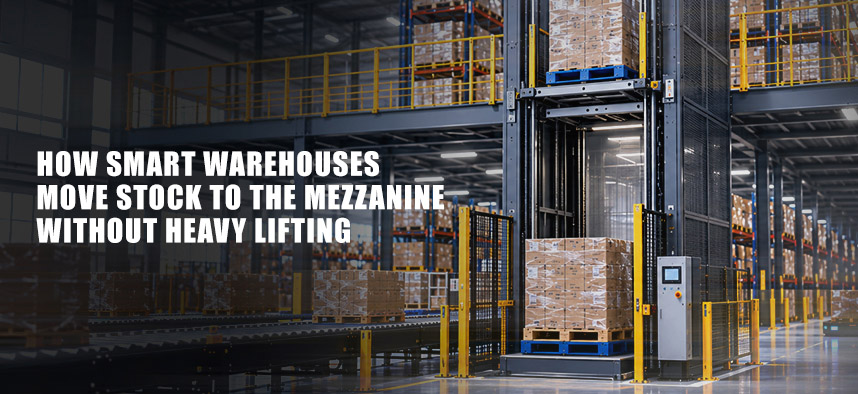
How Smart Warehouses Move Stock to the Mezzanine Without Heavy Lifting
Table of Contents
- Introduction
- Why a Mezzanine Needs a Better Way to Move Stock
- What Is a Mezzanine Goods Lift?
- How Does a Mezzanine Goods Lift Reduce Manual Handling?
- Is a Goods Lift Safer Than Carrying Stock Up Stairs?
- Can a Mezzanine Goods Lift Work in a Space-Tight Premises?
- Mezzanine Goods Lift vs Manual Stair Handling
- Where Can a Mezzanine Goods Lift Be Used?
- What Should Indian Businesses Check Before Choosing One?
- Why the Right Goods Lift Can Make a Mezzanine More Useful
- Choosing an Experienced Elevator Manufacturer
Introduction
A mezzanine can give a warehouse, shop, or commercial premises valuable extra space without expanding its existing footprint. But adding an upper level creates one practical question:
How will the stock get there?
If cartons, components, or packaged goods still have to be carried upstairs, the mezzanine can introduce a new bottleneck. Repeated trips take time, bulky loads are difficult to handle, and workers are left doing a job that can often be managed more efficiently through dedicated vertical transportation. This is where a mezzanine goods lift can make a difference. Designed to move goods between different levels, a goods lift can create a direct route between the ground floor and mezzanine. For Indian businesses operating from space-constrained warehouses, stockrooms, and commercial premises, it can make vertical space much more practical to use.
Your mezzanine adds space. Now move stock without the heavy lifting.
Explore Goods Lift SolutionsWhy a Mezzanine Needs a Better Way to Move Stock
A mezzanine is often introduced because horizontal space is limited. Instead of moving to a larger property, a business can make use of the unused vertical volume within its existing premises. The additional floor may become a storage area, picking zone, packaging section, or stockroom. But the value of that space depends on accessibility.
Consider a warehouse where finished products are stored on the mezzanine while receiving and dispatch happen on the ground floor. If employees need to carry every carton between the two levels using stairs, the storage expansion has created an additional movement requirement.
The same issue can appear in:
- Retail stockrooms
- Distribution facilities
- Commercial storage areas
- Light manufacturing units
- Spare-parts stores
- Packaging and dispatch areas
The challenge isn't always moving heavy goods once. It is moving stock repeatedly, safely, and efficiently throughout the working day.
What Is a Mezzanine Goods Lift?
A mezzanine goods lift is a vertical lifting system used to transfer goods between a lower level and an elevated platform or mezzanine. Unlike a passenger elevator, its primary purpose is the movement of materials and goods, not people.
The concept is simple: Ground Floor → Load Goods → Vertical Transfer → Mezzanine → Unload
This gives businesses a dedicated route for moving stock between levels instead of depending entirely on stair-based manual handling. For a warehouse, the lift can therefore become part of the material-flow process rather than simply another piece of equipment. Epic Elevators offers goods elevators designed for vertical transportation of heavy loads, with applications listed for factories, storage facilities, and industrial units.
Why carry stock upstairs when you can move it smarter?
Find Your Goods LiftHow Does a Mezzanine Goods Lift Reduce Manual Handling?
Suppose a worker needs to move several cartons from the ground-floor stock area to the mezzanine. With stairs, the process involves carrying the load upstairs, returning to the ground floor, and repeating the trip. A goods lift changes the movement pattern. The worker can load the goods into the designated lifting area, initiate the vertical transfer, and unload them at the mezzanine. That does not eliminate the need for people. Workers still need to load, unload, inspect, and organise the goods.
What changes is who does the vertical movement. Instead of a person carrying the stock up the staircase, the lift handles the level-to-level transfer. For businesses with frequent stock movement, this can reduce repetitive manual handling and make the workflow more organised.
Load Capacity Is Only One Part of the Decision
When choosing a mezzanine goods lift, capacity naturally gets attention. But choosing a system simply because it can lift the heaviest possible load may not be the smartest approach.
Start with the actual operation.
What is the heaviest load?
Identify the maximum weight that needs to travel between levels.
What is the usual load?
A lift may operate primarily with cartons or bins even if occasional heavier loads are involved.
How large are the goods?
Weight isn't the only consideration. Cartons, trolleys, equipment, and other loads need sufficient usable loading space.
How frequently will the lift operate?
A few transfers per day create a different operating requirement from continuous stock movement throughout multiple shifts.
How will goods enter the lift?
Manual loading, trolley-based movement, and other handling methods can influence the required configuration.
The right solution is therefore the one designed around the actual load profile and workflow, rather than capacity alone.
More storage space shouldn't mean more trips up the stairs.
Explore Goods ElevatorsIs a Goods Lift Safer Than Carrying Stock Up Stairs?
Reducing repetitive manual handling can be an important advantage. Carrying stock upstairs combines two tasks: handling the load and navigating a change in level. When that movement happens repeatedly, particularly with bulky or awkward goods, it can become physically demanding.
A dedicated goods lift separates those tasks.
Workers can load the goods at the designated landing, while the lift provides the vertical transfer. However, a goods lift should not be considered a safety solution simply because it replaces stairs.
The complete installation matters.
Safe loading and unloading require appropriate access arrangements, guarding, controls and protection around the lift and mezzanine openings. The system also needs to be operated within its specified load and operating conditions. That is why businesses should discuss the site layout and intended application with an experienced elevator manufacturer before finalising a solution.
Can a Mezzanine Goods Lift Work in a Space-Tight Premises?
This is where mezzanine applications become particularly interesting. A business may have very little spare floor area but plenty of unused height. Building another horizontal extension may not be practical. A mezzanine can use that available height, while a goods lift provides the vertical connection. The lift, therefore, needs to be considered as part of the building layout.
Before installation, businesses should assess:
- Available floor area
- Mezzanine position
- Lift travel height
- Loading and unloading points
- Goods dimensions
- Access routes
- Existing structures
- Available headroom
- Future storage requirements
The objective isn't to squeeze a lift into whatever space is left. It is to plan the vertical movement route along with the mezzanine itself.
Put your mezzanine to work without putting the load on your team.
Explore Goods Lift SolutionsMezzanine Goods Lift vs Manual Stair Handling
The difference becomes clearer when you look at the workflow.
| Manual Stair Movement | Mezzanine Goods Lift |
|---|---|
| Goods are physically carried between levels | Goods are transferred vertically by the lift |
| Repeated trips may be required | One controlled lifting cycle can move the load |
| Bulky goods can be difficult to handle | Goods can be transferred through a dedicated route |
| Stair movement can become a bottleneck | Vertical transfer becomes part of the workflow |
| Dependent heavily on manual handling | Reduces repetitive vertical carrying |
The lift does not necessarily replace every handling activity. Instead, it removes one of the more repetitive parts of the process: carrying goods between levels.
Where Can a Mezzanine Goods Lift Be Used?
A mezzanine goods lift isn't limited to large factories. Its usefulness extends to premises where stock needs to move between levels.
- Warehouses: Use the mezzanine for additional storage or picking while maintaining a dedicated route for stock movement.
- Retail Stockrooms: An upper stockroom can provide additional inventory space without making stair-based replenishment the only option.
- Commercial Premises: Businesses with limited floor area can use vertical space for storage and operations.
- Light Manufacturing: Components, materials, and finished products can move between levels without relying entirely on manual carrying.
- Storage and Distribution Facilities: Regular movement between ground-level receiving or dispatch areas and elevated storage can benefit from a dedicated vertical route.
The common factor is simple: The business has useful vertical space but needs a practical way to move goods into it.
Your warehouse has the height. Make every level work harder.
Explore Goods ElevatorsWhat Should Indian Businesses Check Before Choosing One?
Before approaching lift manufacturers in Gujarat or elsewhere in India, prepare the basic details of the application.
- Load: Know the maximum and typical weight of the goods being transferred.
- Load Dimensions: Consider cartons, bins, equipment, pallets or trolleys rather than looking at weight alone.
- Travel Height: The manufacturer needs to understand the distance between the loading and unloading levels.
- Frequency: Explain how often the lift will operate during a normal working day.
- Loading Method: Whether goods are manually loaded or moved using handling equipment can influence the design.
- Available Space: The lift location, landing areas, and surrounding access need to work with the existing building.
- Safety Requirements: The lift and mezzanine interface should be planned around appropriate access protection, controls and safe operating procedures.
- Future Requirements: If stock volumes are expected to grow, consider that before finalising the system.
A good elevator company in Gujarat should be able to understand these requirements and recommend a solution around the application rather than treating every mezzanine as identical.
Why the Right Goods Lift Can Make a Mezzanine More Useful
A mezzanine solves the problem of where to put more stock. A goods lift addresses the next problem: How do you get that stock there?
When the two are planned together, businesses can make better use of vertical space without making every stock transfer dependent on stair-based manual handling. For a space-constrained warehouse or commercial premises, this can mean a more practical material flow, easier stock replenishment, and less repetitive carrying. And that's what makes a mezzanine goods lift more than a lifting system. It becomes the connection that makes the extra floor actually work.
Choosing an Experienced Elevator Manufacturer
Goods movement requirements vary from one premise to another. A warehouse handling cartons may have very different requirements from a manufacturing unit moving components or a commercial stockroom replenishing inventory. That makes the manufacturer-selection process important. Look for an elevator manufacturer in India that can understand the intended application, assess the site, and design the solution around the required load, travel, space, and operating pattern.
Based in Ahmedabad, Gujarat, Epic Elevators provides goods elevator solutions as part of its wider range of vertical transportation systems. The company lists factories, storage facilities, and industrial units among its goods-elevator applications and operates a manufacturing unit in Bavla, Ahmedabad.

