

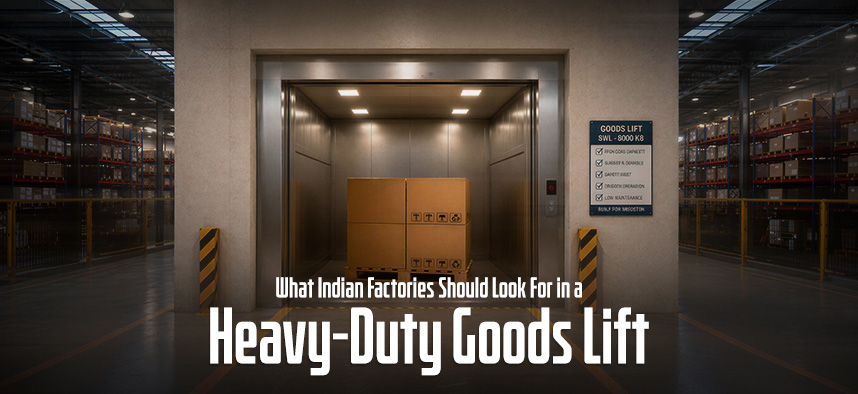
What Indian Factories Should Look For in a Heavy-Duty Goods Lift
Table of Contents
Introduction
In a factory, vertical movement is part of the production process. Raw materials move to different floors. Components travel between manufacturing areas. Finished products move towards storage or dispatch. Heavy machinery and equipment may also need to be transported between levels. When these movements happen continuously, a goods lift is no longer simply a way to move something from one floor to another. It becomes an important part of the factory's material-handling system.
That is why choosing a heavy-duty goods lift requires more than looking at its maximum load capacity.
Indian factories need to consider the type and size of goods being transported, frequency of operation, platform dimensions, floor access, site conditions, safety requirements, maintenance, and applicable Indian standards.
Your factory deserves more than a standard lift.
Find the Right Goods LiftWhat should you actually evaluate before selecting a goods lift for a factory?
1. Begin With the Load You Actually Need to Move
Capacity is naturally one of the first specifications discussed with elevator manufacturers. But the maximum weight of the material is not necessarily the complete load that the lift will carry.
Therefore, the practical load assessment should consider:
- Maximum weight of goods
- Weight of pallets or containers
- Weight of trolleys or handling equipment
- Typical operating load
- Maximum expected operating load
- Future changes in production or material requirements
For example, if a trolley carrying 1,000 kg of material weighs another 150 kg, the lift is handling approximately 1,150 kg during that trip. This is why the right capacity should be determined from the complete operating requirement and then confirmed through technical assessment. Selecting a lift with insufficient capacity can restrict operations, while unnecessarily overspecifying the system can increase project costs.
2. Platform Size Matters as Much as Capacity
Imagine choosing a lift that can carry your heaviest pallet but cannot comfortably accommodate the pallet itself. The capacity may be correct. The application is not. For industrial applications, platform dimensions need to be considered alongside load capacity.
A factory should assess:
- Largest pallet dimensions
- Trolley size
- Machinery or component dimensions
- Door opening width and height
- Loading and unloading clearance
- Available shaft dimensions
- Space required for handling equipment
This is particularly important where pallet trucks, trolleys, or forklifts are used. The platform should allow materials to be loaded and unloaded efficiently without unnecessary repositioning. This is one area where customised solutions can be valuable. Epic Elevators states that its lift solutions are designed around individual project requirements rather than a one-size-fits-all approach.
Moving heavy loads?
Explore Goods Lift Solutions3. Consider How Often the Lift Will Operate
A goods lift used five times a day faces very different demands from one operating throughout multiple production shifts.
Before choosing a system, consider the expected:
- Trips per hour
- Trips per shift
- Operating hours per day
- Average load per trip
- Maximum load per trip
- Number of operating days
This information gives the manufacturer a much clearer picture of the application's demands. Continuous material movement places repeated demands on the lift's mechanical, electrical, and control systems. The lift therefore needs to be specified around the expected operating conditions rather than simply its maximum rated load.
4. Look at the Number of Floors and Travel Height
The number of floors is only part of the equation. A factory may have production floors, mezzanine levels, storage areas, and dispatch zones, all with different floor-to-floor heights.
Before finalising a goods lift, document:
- Number of floors
- Number of stops
- Floor-to-floor height
- Total travel height
- Location of each landing
- Frequency of movement between floors
This information helps the manufacturer determine a suitable configuration. It also allows the lift to be planned alongside the factory's civil and structural requirements instead of being treated as an equipment purchase at the end of construction.
The right lift can keep your factory moving.
Find Your Ideal Lift5. Safety Should Be Considered From the Start
A heavy-duty goods lift routinely handles substantial loads, often in busy industrial environments. Safety, therefore, needs to be considered during design, installation, and operation. Depending on the application and configuration, factories should evaluate provisions related to:
- Door interlocking
- Overload protection
- Emergency operation
- Landing protection
- Braking and control systems
- Safe loading and unloading
- Appropriate signalling and controls
The exact requirements depend on the lift and installation.
What About BIS Standards?
For an Indian factory, standards and local regulatory requirements should be part of the technical discussion. The BIS IS 17900 series addresses lifts for the transportation of persons and goods and includes provisions covering areas such as safety rules, design and component examination, and maintenance. Rather than relying on a generic statement such as "BIS-compliant lift", buyers should ask the manufacturer:
- Which standards apply to this specific installation?
- What safety provisions are incorporated into the proposed design?
- What documentation and inspection requirements apply at the project location?
This gives the factory a much clearer understanding of what it is actually purchasing.
6. Don't Forget the Shaft, Pit, and Headroom
Some lift-related decisions need to happen before the lift is ordered. The available shaft dimensions, pit, headroom, and structural provisions can influence the type of system that can be installed. This becomes particularly important when adding a goods lift to an existing factory.
The manufacturer and civil team should coordinate on:
- Shaft dimensions
- Pit requirements
- Headroom
- Landing openings
- Structural support
- Electrical provisions
- Equipment locations
- Access for installation and maintenance
Getting these details right early can prevent expensive modifications later.
Don’t let the wrong lift slow your production down.
Find the Right Solution7. Maintenance Is Part of the Purchase
A heavy-duty goods lift is a long-term industrial asset. Its value does not end when installation is complete. Regular maintenance and timely service help support reliable operation and identify potential issues before they become major disruptions.
Before choosing among elevator manufacturing companies in India, ask about:
- Preventive maintenance
- Inspection requirements
- Spare-part availability
- Service support
- Technical assistance
- Breakdown response
- Long-term maintenance requirements
For a factory, downtime can have a direct impact on production and material movement. That makes after-sales support an important part of the buying decision, not an optional extra. Epic Elevators includes maintenance and support as part of its overall elevator service approach, alongside consultation, design, manufacturing, and installation.
8. Compare Manufacturers Beyond the Quotation
A heavy-duty goods lift is a long-term investment, so the lowest initial quotation should not automatically win. When comparing elevator manufacturers in India or elevator manufacturers in Gujarat, look at the complete solution.
- Engineering Capability: Can the manufacturer understand your factory layout, load, and operating requirements?
- Customisation: Can the platform, access arrangement, and other specifications be adapted to the site?
- Manufacturing: Does the manufacturer have an established production facility and technical team?
- Installation: Can the company coordinate effectively with civil, electrical, and structural teams?
- Safety: Are applicable Indian standards and project-specific requirements being addressed?
- Maintenance: What support will be available after commissioning?
A manufacturer should be evaluated on the complete lifecycle of the lift rather than the purchase price alone.
The biggest lift isn’t always the right lift.
See What Your Factory NeedsFrequently Asked Questions
1. What is a heavy-duty goods lift?
A heavy-duty goods lift is designed for the vertical transportation of materials and goods in applications such as factories, warehouses, and industrial facilities. Its capacity, platform dimensions, and configuration are selected according to the material-handling requirements of the installation.
2. How do I calculate the required goods lift capacity?
Start with the maximum weight of the goods and add the weight of the pallet, trolley, or handling equipment that will enter the lift. The resulting operating load should then be assessed against the required lift capacity and application conditions by the manufacturer.
3. Is platform size important for a factory goods lift?
Yes. The platform must accommodate the largest goods and handling equipment being transported. Door dimensions and loading clearance should also be considered.
4. Can a goods lift be customised for a factory?
Yes. The configuration can be planned around factors such as load, platform dimensions, number of floors, travel height, landing arrangement, and site conditions. The exact possibilities depend on the project and the manufacturer's engineering capabilities.
5. What should I look for in goods lift manufacturers in Gujarat?
Look beyond price. Consider engineering expertise, manufacturing capabilities, customisation, safety approach, installation experience, maintenance support, and experience with industrial applications.
Choosing a Goods Lift Is Really About Choosing the Right Material-Handling System
A factory does not need a goods lift simply because it has multiple floors. It needs one because materials need to move between those floors reliably, safely, and efficiently.
That means the right selection should begin with the factory's actual workflow.
- Look at the load.
- Look at the dimensions.
- Look at the number of trips.
- Look at the floor access.
- Look at the site conditions.
- Look at the applicable standards.
- And look beyond installation to maintenance and long-term support.
For businesses comparing elevator manufacturers, lift manufacturers, elevator manufacturers in India, or elevator manufacturers in Gujarat, these factors provide a more useful basis for comparison than price or capacity alone.
Epic Elevators for Industrial Goods Movement
Epic Elevators is an Ahmedabad-based elevator manufacturer with a manufacturing facility in Gujarat and a portfolio that includes goods elevators for factories, storage facilities, and industrial units. Its goods-elevator offering focuses on efficient and reliable vertical transportation of heavy loads, while the company's broader approach covers consultation and design, manufacturing and installation, and maintenance and support. With an emphasis on tailored elevator solutions, Epic can work with businesses to assess their site and application requirements before determining a suitable goods-lift configuration. Because when your factory depends on vertical material movement, the right lift isn't simply the one that can carry the most. It's the one engineered around the way your factory works.

