

Why do some small house lifts take longer to repair than others?
A home lift makes everyday movement between floors easier. However, when it stops working, that convenience can quickly turn into frustration. You may wonder whether it is a minor fault or a repair that could keep the lift out of service for days.
The repair time depends on more than the problem you see. For instance, the type of fault, availability of spare parts, lift design, and service support all play a role. Therefore, understanding these factors can help you know what to expect and make better decisions about your lift.
Let's look at why some home lifts take longer to repair and what can help get them running again.
Table of Contents
- What happens during a home lift repair?
- 6 reasons why some home lift repairs take longer
- Why can the same lift problem take different times to fix?
- Does a quick service visit mean a quick repair?
- How can homeowners help reduce repair delays?
- What should you check before choosing a home lift?
- FAQs
- Conclusion
What happens during a home lift repair?
A home lift repair usually involves four steps. Each step helps the technician find and fix the problem.
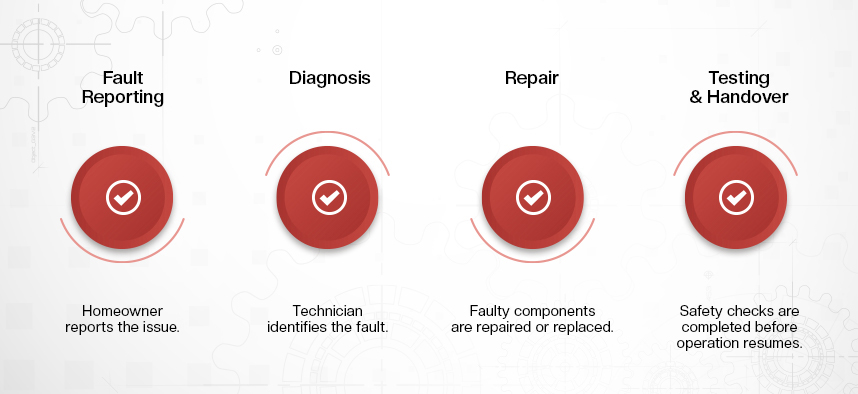
Some faults can be fixed during the first visit. Others need more checks or new parts. This is why repair times can vary from one lift to another.
Exploring a small lift for your home?
Discover home elevator solutions designed to suit your space, layout, and everyday needs.
Explore home lift solutions6 reasons why some home lift repairs take longer
1. The type of fault
Not all lift problems need the same repair work. Some affect a single part. Others may involve several parts of the lift.
For example, a door that does not close may have a faulty sensor or a problem with its alignment. A technician can check these parts and decide what needs to be fixed.
But a lift that stops without warning may need a wider check. The technician may inspect the motor, controller, wiring, and safety system.
For a better understanding of common lift problems and their causes, read our guide to common elevator failures and what causes them
2. Finding the actual cause of the problem
The visible problem is not always the cause of the fault. A lift may show one sign of trouble, while the real issue lies in another part.
For example, a lift may stop responding to floor buttons. The cause could be a problem with the control panel, wiring, or controller. The technician must check the system before choosing the right fix.
Some faults also happen only from time to time. The lift may work during the inspection but stop again later.
In such cases, the technician may need to check error codes and past service reports. Finding the exact cause helps avoid repeat repairs and wasted effort.
3. Availability of replacement parts
A repair may stop until the right replacement part is available. Common parts are often easier to source. But some lifts use parts made for a specific model or system.
The technician must also check that the new part is suitable for the lift. A part that looks similar may not be safe or compatible.
A study by Ontario's Technical Standards and Safety Authority (TSSA) also points to the role of spare parts in lift downtime. The study looked at service records for about 5,500 devices. It found that 98% returned to service within 24 hours. It also linked longer outages to rare parts, skilled workers, or major repairs.
These figures come from Ontario, Canada. They do not show the usual repair time for home lifts in India. However, they show why access to the right parts can affect repair work.
Homeowners should ask if the manufacturer can supply common parts. It is also worth checking how they support older lift models.
4. Lift design and access to parts
The design of a home lift can affect how easy it is to repair. Home lifts often need to fit into small spaces. This means the layout and location of parts can vary.
In some lifts, a technician can reach the faulty part with ease. In others, limited space can make the work harder. The technician may need more time to reach, inspect, or replace the part.
A glass lift for home may have a different layout from a standard enclosed lift. Its glass design does not mean repairs will take longer. The actual layout and location of its parts matter more.
The same applies to compact and machine-room-less lifts. Some parts may sit within or near the lift shaft. Technicians must follow the right steps to reach them safely.
So, even a simple repair can take longer if the faulty part is hard to reach.
5. The age and service history of the lift
The age of a lift does not always decide how long a repair will take. Its condition and service history also matter.
A lift with regular service records gives technicians useful details. These records show past faults, repairs, and part changes. This can help them find the cause of a new problem.
Without these records, the technician may need extra time to check the lift's condition. They may also need to find out if the same fault has happened before.
Older lifts can bring another challenge. Some parts may no longer be easy to find. The service team may need more time to source a suitable replacement.
In India, IS 15259:2002 sets out a code of practice for the installation and maintenance of home lifts. Regular inspections also play an important role in lift upkeep. Learn more in our guide on how often elevators should be inspected.
6. Access to skilled service support
The repair time also depends on the service team. Different lift models may use different parts and control systems. So, technicians need the right skills and knowledge to work on them.
A trained technician can check the lift, read error codes, and find the cause of a fault. But some problems may need expert help or advice from the manufacturer.
The TSSA study also points to skilled workers as one factor that can affect lift downtime. While the study covers Ontario, it highlights an important point: the right technical support matters during a repair.
When choosing among elevator manufacturers in India, look at the service support they offer after installation. Check if they can arrange inspections, provide technical help, and supply the right parts when needed.
Need reliable support for your home elevator?
Explore EPIC's maintenance services for ongoing care and dependable elevator support.
Explore maintenance servicesWhy can the same lift problem take different times to fix?
Two lifts may show the same problem but need different repairs. This is because the visible sign does not always tell you which part has failed.
For example, two lifts may stop responding to floor buttons. One may have a loose wire. The other may have a faulty controller.
The first issue may need a simple check and repair. The second may need more testing and a new part.
Here are some common examples:
| Lift problem | What the technician may check | What can affect repair time |
|---|---|---|
| Door does not close | Sensors, locks and door alignment | Condition of the part and the work needed |
| Lift does not respond | Control panel, wiring and controller | Time needed to find the fault and source parts |
| Unusual noise or movement | Motor, drive system and moving parts | Number of parts that need checking |
| Lift stops between floors | Safety systems and cause of the stoppage | Type of fault and safety checks needed |
| Same fault keeps returning | Past service records and connected parts | How quickly the main cause can be found |
These are general examples, not fixed repair times. A technician must inspect the lift before giving a repair estimate.
Does a quick service visit mean a quick repair?
Not always. The time taken to reach your home and the time needed to fix the lift are two different things.
A service team may send a technician on the same day. But the repair may still need more checks, expert help, or a new part.
For example, the technician may find a faulty controller during the first visit. If the right replacement is not available, the lift may remain out of use until the part arrives.
Homeowners should ask the service team three simple questions:
- When can a technician visit? This tells you the expected response time.
- When will the fault be clear? This helps you understand when the team expects to find the cause.
- When can the lift work again? This depends on the repair, parts, and final checks.
These questions help set clear expectations. They also make it easier to understand why a repair may take longer than the first visit.
How can homeowners help reduce repair delays?
Homeowners cannot control every part of a repair. But they can share useful details and keep the right records. This can help the technician find the problem sooner.
1. Explain the problem clearly
Tell the service team what happened. Mention if the lift stopped between floors, made a strange sound, or failed to respond to a button.
If the problem happens only sometimes, explain when it occurs. Do not try to make the fault happen again on your own.
2. Keep service and repair records
Keep records of past checks, repairs, and part changes. Share them with the technician during a service visit.
These details can help the technician spot repeat faults. They may also reduce the time needed to check the lift's history.
3. Follow the recommended service schedule
Regular service helps technicians check key parts and spot signs of wear. It may also help find small issues before they become bigger problems.
The right service schedule depends on the lift model and the manufacturer's advice. Follow the guidance given for your lift instead of using the same schedule for every model.
You can also learn why planned servicing matters in our guide to annual maintenance contracts for elevator safety
4. Ask about spare parts and service support
Before buying a lift, ask the manufacturer about spare parts. Find out how they support older models and how they handle repairs that need special parts.
This is useful when choosing an indoor lift for house use. The design, parts, and service needs can vary across models.
5. Avoid repairs on your own
Do not try to open control panels or enter the lift shaft. Do not adjust parts yourself. These actions can cause harm and make the fault worse.
Contact the service team or a trained lift technician. If someone is trapped inside, follow the lift's emergency steps and call the service team. Never try to force the doors open.
What should you check before choosing a home lift?
Repair support is worth checking before you buy a lift. The design matters, but so does the help you can get after installation.
When comparing small house lifts, look at these points:
- Service support: Check if the manufacturer has service support in your area.
- Spare parts: Ask how easily they can supply common and model-specific parts.
- Maintenance needs: Understand how often the lift needs checks and servicing.
- Product details: Ask for clear guides on how to use and care for the lift.
- Repair support: Find out how they handle service calls and urgent repairs.
Choose a lift that suits your home and daily needs. Also, check that the manufacturer can support it after installation.
Looking for the right home elevator?
Explore residential elevator solutions designed to suit different spaces and home layouts.
Explore EPIC elevator solutionsFrequently asked questions
1. Why does a home lift stop working again and again?
Repeated stoppages may point to a fault that has not been fixed. The cause could be a sensor, loose wire, controller, or another part. A trained technician should check the lift to find the main cause.
2. Can spare parts affect home lift repair time?
Yes. Some parts are easy to find, while others are made for a specific lift model. If the right part is not available, the repair may take longer. The technician must also check that the new part is safe and suitable.
3. Do glass lifts for homes take longer to repair?
Not always. A glass lift does not need more repair time just because it has a glass design. The repair time depends on the fault, the lift system, and how easy it is to reach the affected part.
4. Can regular maintenance reduce lift repair delays?
Regular maintenance helps spot wear and faults early. It also gives technicians a record of past repairs and checks. However, it cannot prevent every fault or promise a fixed repair time.
5. What should I check before choosing a home lift manufacturer?
Check the manufacturer's service support, spare parts, and maintenance plans. Also ask about local service teams and help with repairs. Review the lift's safety features and product details before you make a choice.
Conclusion
A home lift should make everyday life easier. However, that convenience also depends on how well the lift is supported when a fault occurs. While some repairs are simple, others need more time, the right parts, and skilled technical support.
Fortunately, a few simple steps can help make the repair process smoother. Clear fault reporting, regular servicing, and proper repair records can help technicians identify problems and plan the work.
So, when choosing a small lift for home, think beyond how it looks or performs on a normal day. Instead, consider how easily it can be serviced, where replacement parts will come from, and who will support it when you need help. After all, the real value of a home lift lies in the convenience it offers, day after day.
Make the right choice for your home
Find a home elevator that meets your needs, with the right support beyond installation.
Get in touch with EPIC
