

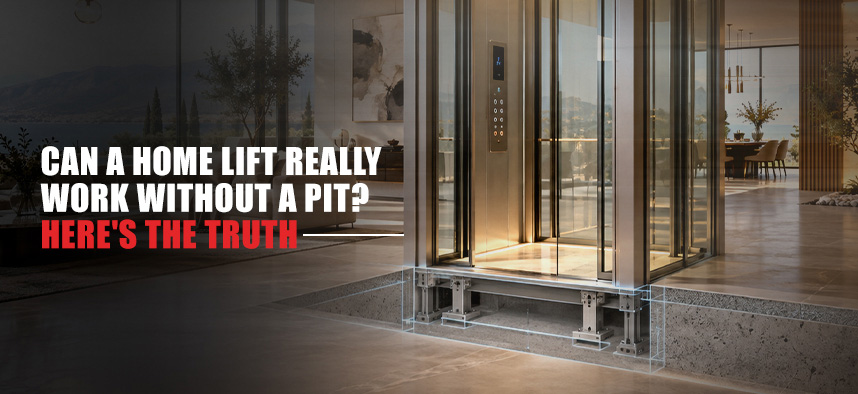
Can a Home Lift Really Work Without a Pit? Here's the Truth
Table of Contents
- Introduction
- What Does "No Pit" Actually Mean in a Home Lift?
- No Pit Doesn't Mean No Civil Work
- What Does "No Machine Room" Really Mean?
- Does "No Overhead" Mean No Space Is Required Above the Lift?
- What Buyers Often Get Wrong About Pitless Home Lifts
- Vacuum Tube Lift vs Cabin Lift at a Glance
- Can You Have a Glass Lift for Home Without Choosing a Tube Lift?
- Where Does Epic's No Pit, No Overhead Cabin Lift Fit In?
Introduction
“No pit. No machine room. No overhead.”
If you are looking for a small lift for home, you have probably come across these promises more than once. For homeowners with an existing bungalow, villa, or duplex, they sound like the perfect solution. No deep excavation. No major reconstruction. No sacrificing an extra room for lift machinery.
But can a home lift really work without a pit?
Yes, but the truth is more nuanced than the marketing.
Modern home lifts can significantly reduce the structural requirements associated with conventional elevators. Some can avoid a deep pit, a separate machine room, and extensive overhead construction. However, those three claims do not mean exactly the same thing for every lift. The type of lift, installation design, available space, and the experience you expect from the lift all matter. And this is where buyers need to look beyond the phrase “pitless home lift.”
Before you believe “No Pit,” find out what your home really needs.
Check Your Home Lift FeasibilityWhat Does "No Pit" Actually Mean in a Home Lift?
A conventional elevator typically requires a pit below the lowest floor level. This space forms part of the elevator's overall installation and operating arrangement. For an existing home, creating that pit can mean additional civil work. Floors may need to be modified, and the project can become more complicated depending on the building. This is why many homeowners specifically search for a small house lift that can be installed with reduced construction work.
However, here is the important distinction: No deep conventional pit does not always mean absolutely no preparation at floor level.
Depending on the lift design, a home lift may use:
- A floor-level installation
- A specially designed base arrangement
- A shallow floor provision
- A threshold or ramp solution
- Site-specific floor preparation
The actual requirement depends on the lift model and the property.
No Pit Doesn't Mean No Civil Work
This is one of the biggest misunderstandings around pitless home lifts. Reducing or eliminating the need for a deep pit can make installation easier, particularly in existing homes. But a lift still needs proper planning and integration.
Before recommending an indoor lift for a house, factors that need to be evaluated can include:
- Available installation space
- Existing floor condition
- Floor-to-floor layout
- Location of openings between levels
- Structural arrangement of the property
- Access during installation
- How the lift will be used every day
A genuine pitless solution can reduce unnecessary construction. But it should not be sold as though every property requires zero planning. Evaluate the right lift around the home, not simply because its brochure says “no pit.”
No pit sounds easy. The right lift makes the difference.
Find Your Right LiftWhat Does "No Machine Room" Really Mean?
Traditionally, elevators could require dedicated space for machinery and related equipment. For a home, giving up an additional room can be inconvenient. Modern home-lift systems can integrate essential equipment into the lift arrangement, reducing the need for a separate machine room. That can be a major space advantage. But again, no machine room does not mean no equipment. The important question is where the components are integrated and how servicing and maintenance access are planned.
Before buying a lift, ask: Where are the essential operating components located, and how will they be accessed when the lift requires service?
A reliable manufacturer should be able to explain this clearly.
Does "No Overhead" Mean No Space Is Required Above the Lift?
Not necessarily.
This is another claim that deserves a closer look. Conventional elevators can require significant headroom or overhead construction above the highest landing. For existing homes, accommodating that space can become difficult if the roofline cannot be modified. Some home lifts are designed specifically to reduce the overhead requirements associated with conventional elevator installations. That can make them more practical for villas, bungalows and duplexes where extensive construction above the top floor is not desirable. However, homeowners should avoid interpreting “no overhead” as: “The lift requires absolutely no consideration of the space above it.” The actual requirements depend on the lift design and installation configuration.
The honest approach is simple: check the requirements of the exact lift being proposed for your home.
Don’t buy the claim. Check what actually works for your home.
Explore Home Lift OptionsWhat Buyers Often Get Wrong About Pitless Home Lifts
When comparing home lifts, the biggest mistake is focusing on a single marketing claim.
Here are a few things buyers often misunderstand.
"No Pit" Does Not Always Mean Zero Preparation
A lift can avoid a deep conventional pit while still requiring proper floor-level planning.
"No Overhead" Does Not Mean Every Home Is Automatically Suitable
The top-level configuration still needs to work with the specific lift and property.
The Smallest Lift Is Not Always the Most Comfortable
A compact footprint may solve a space problem, but the experience inside the lift can be very different.
A Low-Construction Lift Can Still Have Design Trade-Offs
Different technologies prioritise different things: space efficiency, visual appearance, cabin experience, or structural simplicity.
The Right Lift Depends on How You Will Actually Use It
A lift used occasionally by one person can have very different requirements from a lift used daily by multiple family members.
This is why homeowners should compare the complete experience, not just the installation promise.
Vacuum Tube Lift vs Cabin Lift at a Glance
| What to Compare | Vacuum Tube Lift | Cabin Lift |
|---|---|---|
| Overall design | Cylindrical and self-contained | Defined elevator-style cabin |
| Interior experience | Compact, tube-style travel space | More familiar cabin experience |
| Visual appeal | Transparent and visually distinctive | Can be integrated with the home's interior design |
| Space experience | Depends on the circular layout | Depends on the cabin design and configuration |
| Best for | Homes prioritising a compact, self-contained concept | Homeowners prioritising a cabin-style lift experience |
| Buying priority | Compactness and distinctive appearance | Comfort, finish and a more conventional elevator feel |
The better choice depends on what matters more to you.
Think “No Pit” means no hassle? Think again.
Check Your Lift OptionsCan You Have a Glass Lift for Home Without Choosing a Tube Lift?
Yes.
One common misconception is that a glass lift for home must always mean a cylindrical vacuum tube.
A cabin-style home lift can also be designed to create a visually open and premium appearance, depending on the lift configuration and finishes available.
This can be particularly relevant for homes where the lift is installed in a visible location, such as:
- A central living area
- A staircase opening
- A double-height space
- A private villa interior
- An architectural focal point within the home
The important consideration is not simply whether the lift uses glass. It is how the lift integrates with the architecture around it. A visually striking lift should still work practically for the people using it every day.
Where Does Epic's No Pit, No Overhead Cabin Lift Fit In?
Epic Elevators offers the Bellissimmo home lift, including a No Pit, No Overhead cabin-lift configuration. The relevance of this type of solution is not simply that it can reduce conventional construction requirements. The bigger consideration is what homeowners get in return. For many buyers, the challenge is finding a lift that works within an existing home's limitations without making the interior experience feel like a compromise. A cabin lift can offer an alternative for homeowners who want to explore reduced pit and overhead requirements while still prioritising the experience of travelling in a proper cabin. However, the final suitability should always depend on the property, available space, and installation assessment. There is no single home lift that is automatically right for every house.

